
You may know how to find angles and side lengths of a triangle using Geometry with mechanisms such as SAS (side-angle-side), SSS (side-side-side), and ASA (angle-side-angle). However, there are also simple methods in trigonometry to calculate these measurements.
An example of when this might be useful is if you know the SSA (side-side-angle) of the triangle. None of these Geometry rules with help you in this case. However, if the triangle in question is a right triangle (one of the sides is 90°), Trigonometry may help you. For example, the triangle below.
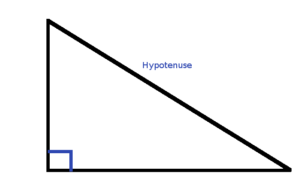
The hypotenuse is labeled; it will always be the longest side and will be opposite of the right angle. The right angle is denoted with a blue square.
Let's assume that the horizontal side of this triangle is 12 units long, and the vertical side is 5 units tall, and that we want to find the bottom-right angle.
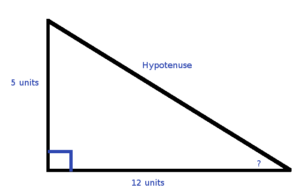
Trigonometry - like Geometry - has 3-letter pneumonics to help remember the rules: SOH (the sine is the opposite over the hypotenuse), CAH (the cosine is the adjacent over the hypotenuse), and TOA (the tangent is the opposite over the adjacent).
So, for instance, to solve for this angle, we need to take the side opposite of the angle that we are trying to find (5 units) and divide it by the adjacent side (12 units). The opposite side - as the name implies - is the across from the angle. The adjacent side is the side that forms one leg of the angle (the hypotenuse forms the other leg).
tan(angle) = 5/12 = 0.41666666667
Then, since this gives us the tangent of the angle, we need to calculate the arc tangent (inverse of the tangent similar to how subtraction is the opposite of addition or multiplication is the opposite of division) to get the actual angle.
angle = arctan(0.41666666667) = 22.6°
Now that we have two angles (90° and 22.6°) and we know that triangles are 180°, we can calculate the final angle.
180° - (90° + 22.6°) = 67.4°
We also know that taking the cosine of this angle will get us the adjacent side over the hypotenuse.
cos(67.4°) = 5/h
0.38429532276 = 5/h
0.38429532276h = 5
h = 5/0.38429532276
h = 13
So, now we have calculated all of the missing angles and sides using Trigonometry. For practice, calculate the top-left angle using TOA. We already know that this angle is ~67.4° so you can use that to check your answer.